
Profile
Voice introductions
Record a 12-60 second clip in your own tone and personality. Other members hear who you actually are - calm, witty, curious, kind - instead of guessing from a written bio.
Blind dating · Voice-first · Free to join
Built for blind, low vision, monocular, and partially sighted singles - and the sighted allies who already know that a great date does not need a perfect selfie. Voice introductions instead of headshot pressure, profile read-aloud, captioned video chat, and a UI that JAWS, NVDA, VoiceOver, and TalkBack actually respect.
Free to join · No credit card · Voice profiles welcome instead of photos
Voice-first by design
For many blind and low vision singles, voice feels more natural than text or photos. A 12-second voice clip carries warmth, humour, and sincerity in a way a headshot never quite manages. On this blind dating app the entire courtship can happen in audio if you want it to - from the first hello to the moment you swap real numbers. No selfie tax, no awkward "do I look okay in this light" anxiety, no built-in assumption that romance is something you read with your eyes.
Record a 12-60 second clip in your own tone and personality. Other members hear who you actually are - calm, witty, curious, kind - instead of guessing from a written bio.
Three-tap voice notes inside any chat. Conversation flows more naturally when typing or reading feels tiring, and tone of voice does the heavy lifting that emojis cannot.
Every profile can be read aloud at adjustable speed, in clear synthesized speech or by your own screen-reader. Listen on the bus, on a walk, or with eyes resting after a long day.
Answer warm spoken questions like "describe your perfect Sunday" in 30 seconds. Audio prompts replace photo grids, so profiles sound like people instead of looking like ads.
Prefer a written profile? Mix and match - photos, text, voice, and audio prompts are all optional. The platform respects whatever combination works for you.
Built for assistive tech
Most mainstream dating apps treat accessibility like an afterthought. Swipe gestures break with VoiceOver. Bio fields read as a single run-on sentence. Action buttons are labeled "button button button." We rebuilt the experience around assistive technology, not around it.
Independent WCAG 2.2 AA audits run quarterly. Bug reports from blind users go to a dedicated accessibility queue and are usually fixed inside a week, not a sprint.
If your screen-reader is missing from this list, email us - we add new combinations to the regression test suite within 30 days.
"First dating app I have ever signed up to where I did not have to ask a sighted friend to walk me through registration. I cried a little, then I matched with someone in Tucson." - Devon, 38, totally blind, VoiceOver user
Low vision & monocular
Visually impaired dating gets flattened into "blind vs sighted" far too often. The truth is messier and more interesting. Some members have vision in one eye and full sight in the other. Some have central vision but no periphery. Some have peripheral vision but no center. Some see well in bright daylight and almost nothing after dusk. All of you belong here, and all of you get tools tuned for your reality - not the average of everyone else's.
Vision in one eye is often overlooked in dating discussions. Depth perception, low-light comfort, and unfamiliar-environment anxiety are real - and they belong on your profile if you want them there.
Filter for daters who are comfortable describing surroundings, ordering Lyft together, or choosing well-lit venues. Small accommodations, named in advance, prevent awkward dates two.
Text size from 14px to 32px, contrast modes, reduced motion, and a calm-dark mode tuned for photophobia. Save your preferences once and they follow you across devices.
Members with low or monocular vision often hear this on first dates - usually as a strange compliment that is actually a tiny erasure. Our profile prompts give you the language to set the record straight in two sentences, so the conversation moves past it and on to the part where you actually get to know each other.
Safety
Online dating safety looks a little different when you cannot rely on visual scanning to read a room. The good news: most of the same habits that protect any dater work even better when you build them in early. Trusting your instincts is not a weakness - it is part of dating well, and your gut is usually faster than your eyes anyway.
Voice verification before meeting saved me from at least two catfish profiles. If someone refuses to send a 20-second voice clip, that is data, and I trust the data.
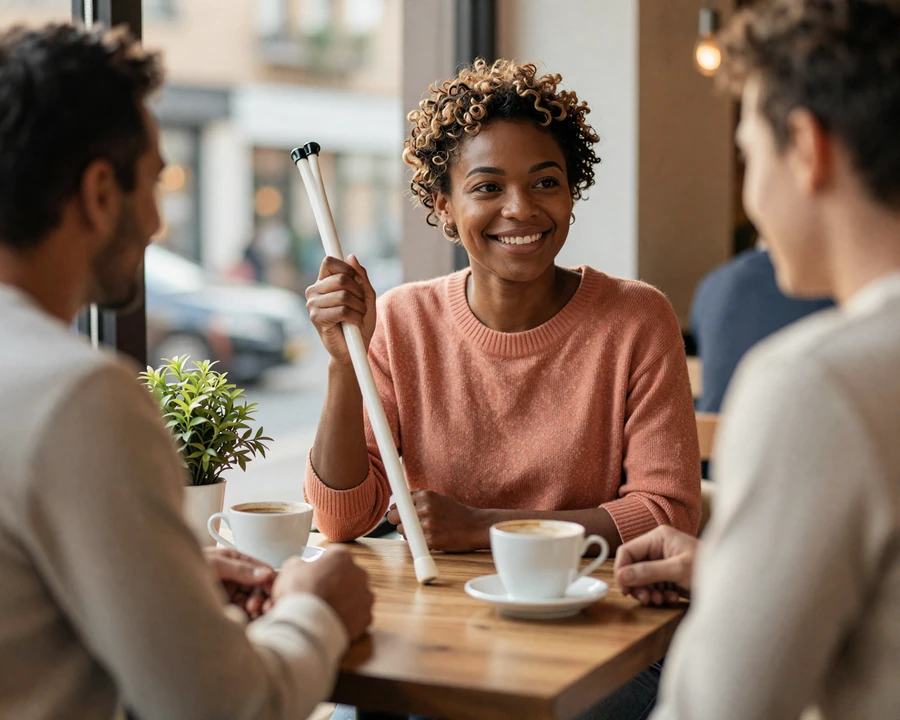
If you use a guide dog or a white cane, you have every right to mention it casually - or not at all - in your bio. It is a tool, not a personality. For deeper safety guidance read our safety tips page and the online dating safety guide.
Disclosure
There is no correct timeline for telling matches you are blind, partially sighted, or have monocular vision. Some members lead with it in their first photo caption. Others wait until the first voice call. Both are valid. Disclosure works best when it feels like a choice, not an obligation - and when the conversation is about your real practical needs, not a label someone else hangs on you.
Direct: "Totally blind, VoiceOver user, guide dog named Juno. Looking for someone who is curious, kind, and likes long walks where I do most of the talking and Juno picks the route."
Soft mention: "Low vision - I prefer quiet, well-lit venues and a heads-up about the menu. Easy to plan with, hard to surprise."
Wait-and-see: No profile mention. Bring it up on the first voice call, framed as practical: "Quick heads up before we plan - I have vision in one eye, so I'll suggest a place that's easy to navigate."
For full scripts across every condition, read how to disclose your disability when dating.
For sighted allies
If you are sighted and matched with a blind, low vision, or monocular partner, the most useful thing you can do is treat the relationship like any other - with a few small adjustments around environment and communication. Most discomfort on first dates comes from over-helping, not under-helping. Ask first, lead second.
Answers
Dating can feel harder on visual platforms designed around swiping through photos, but it is meaningfully easier on accessible ones. A blind dating app with voice introductions, profile read-aloud, captioned video chat, and full screen-reader support removes the friction that makes mainstream apps frustrating, and lets the actual matching happen on personality and values.
Use a platform with screen-reader support, verified profiles, and voice communication. Verify a match with a short voice clip or captioned video call before meeting. Choose a familiar, quiet public venue for the first date, share live location with a trusted friend, and use in-app block and report buttons the moment something feels off.
No. Photos are entirely optional. You can build a complete profile using only voice introductions, audio prompts, and written text, and you will still be matched with members who are explicitly interested in voice-first dating. Many of our most successful couples never exchanged photos at all before meeting.
There is no fixed rule. Some members put it in their first profile line, others wait for the first voice call. Disclosure works best when it feels like a choice rather than an obligation. Lead with it if you want practical filters working from match one; hold it for later if you prefer to build rapport first.
It is reasonable to mention monocular or low vision if it affects your comfort and safety on a date - for example, preferring well-lit venues or a brief description of the room on arrival. Many members find that naming it once on the profile prevents the same conversation from repeating across every first date.
Voice verification is the single most useful tool. Ask any new match for a 20-second voice note answering a specific question - what they did this weekend, why they joined the app. AI voice clones still struggle with spontaneous specifics. Pair this with verified profile badges and a short captioned video call before meeting.
Absolutely. Successful relationships for blind and visually impaired daters are built on the same foundations as any healthy partnership: clear communication, shared values, trust, mutual respect, and practical teamwork around environment and logistics. There is nothing about being blind that limits the depth of a long-term relationship.
Yes. The free tier includes unlimited likes, profile views, voice introductions, voice messages, profile read-aloud, captioned video chat, and full screen-reader support. Premium is $4.99 a month and adds advanced filters and who-liked-you visibility. Most blind members meet partners on the free tier.
Related communities
ASL-friendly profiles, captioned video chat, communication preference filters, and a Deaf-hearing ally matching system rooted in Deaf culture.
Explore deaf datingVenue accessibility filters, inter-ability matching, profile tips that center independence, and a community where chairs are normal, not novel.
Explore wheelchair datingDisclosure strategies, anti-fetishization moderation, body-image-affirming community standards, and date ideas that respect prosthetic use.
Explore amputee datingStart from the top? Visit the disabled dating site homepage or read the 2026 disabled dating statistics.